The event management industry has grown rapidly over the last decade. Conferences, exhibitions, trade shows, corporate events, and festivals are becoming more complex each year. While the scale of events continues to increase, many event management companies are still running their operations using manual systems and disconnected tools.
Spreadsheets, emails, multiple software platforms, and manual coordination often create operational inefficiencies that directly impact profitability.
This article explains the common operational problems event companies face and how an integrated platform like Odoo Event Management System can solve them.
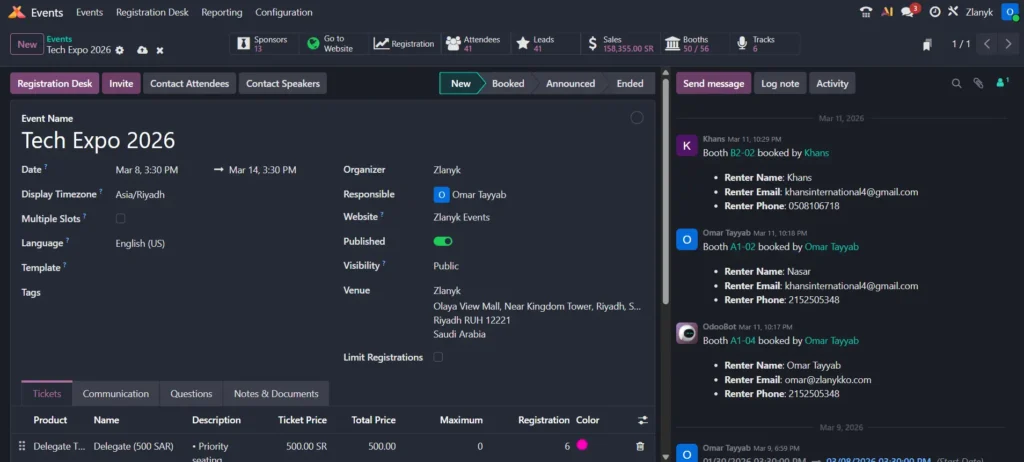
The Reality of Event Operations Today
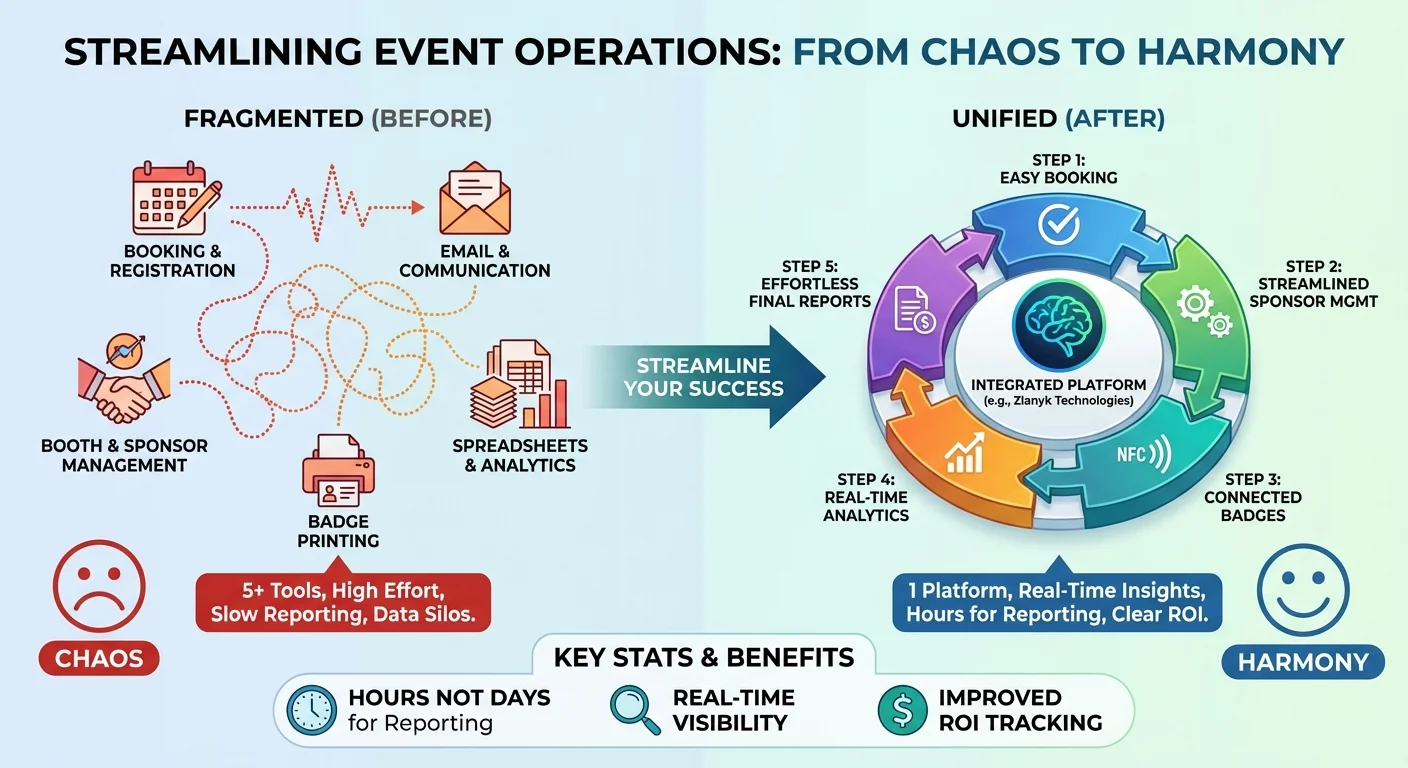
Many event companies rely on a mix of tools to manage their events. A typical workflow often looks like this:
- Booth bookings tracked in Excel spreadsheets
- Exhibitor communication handled via emails and messaging apps
- Payments tracked in separate accounting software
- Sponsor management done through manual documentation
- Badge printing handled through external systems
- Attendance tracked using scanners with no centralized analytics
At first, this approach seems manageable. But as the event grows larger, these disconnected processes begin to create serious operational challenges.
Major Problems Caused by Manual Event Operations
1. Booth Booking Conflicts
When booth bookings are managed manually, it becomes difficult to maintain a clear overview of availability. Multiple team members may update the same spreadsheet, which can lead to:
- Double bookings
- Incorrect booth assignments
- Miscommunication with exhibitors
Such errors not only damage relationships with exhibitors but also affect the reputation of the event organizer.
2. Payment Tracking Issues
Many event companies track payments separately from their booking systems. This creates problems such as:
- Unpaid exhibitors occupying booths
- Delays in invoice generation
- Difficulty reconciling payments with registrations
When financial data is not linked directly to event operations, teams often spend hours verifying payment status manually.
3. Poor Coordination Between Teams
Event operations involve multiple teams including:
- Sales
- Operations
- Marketing
- Finance
- On-site event staff
When each team uses different systems, coordination becomes complicated. Important information can easily get lost between departments, leading to operational confusion.
4. Inefficient Badge Printing and Check-in
Registration and badge printing are critical parts of any event. Without automation, organizers often face issues such as:
- Long queues at registration counters
- Manual badge printing delays
- Difficulty verifying attendee registrations
- Lack of real-time attendance tracking
These issues directly affect the attendee experience.
5. Lack of Real-Time Event Insights
One of the biggest limitations of manual operations is the absence of real-time data. Event organizers often struggle to answer questions like:
- How many booths are sold?
- How many attendees have registered?
- Which sponsors are confirmed?
- What is the total event revenue so far?
Without a centralized system, generating accurate reports becomes difficult and time-consuming.
The Solution: Integrated Event Management with Odoo
To overcome these challenges, many event companies are adopting integrated event management platforms.
One of the most powerful solutions available today is Odoo Event Management System, which allows organizers to manage the entire event lifecycle from a single platform.
Instead of relying on multiple tools, Odoo centralizes all operations in one system.
Key Capabilities of Odoo for Event Management
Booth and Floor Management
Organizers can manage booth bookings directly within the system, allowing teams to:
- View booth availability in real time
- Assign booths to exhibitors
- Prevent double bookings
- Manage event floor layouts
Exhibitor and Sponsor Management
Odoo enables event companies to maintain complete profiles of exhibitors and sponsors, including:
- Contract details
- Payment status
- Communication history
- Booth allocation
This ensures that all event stakeholders are managed efficiently.
Automated Invoicing and Payments
Financial processes can be integrated directly into the event system. This allows organizers to:
- Generate invoices automatically
- Track payment status
- Integrate payment gateways
- Maintain financial transparency
This significantly reduces administrative work.
Registration and Badge Management
With automated attendee registration and check-in, event organizers can:
- Manage online registrations
- Print badges automatically
- Enable barcode or QR code check-ins
- Monitor real-time attendance
This improves the overall experience for attendees.
Real-Time Event Analytics
One of the biggest advantages of using a centralized platform is access to real-time dashboards and reports.
Organizers can instantly view:
- Booth sales performance
- Sponsor revenue
- Registration statistics
- Attendance data
- Event profitability
These insights allow organizers to make faster and better decisions.
The Future of Event Operations
The event management industry is becoming increasingly competitive. Companies that rely on manual processes will struggle to scale their operations efficiently.
Modern event companies are moving toward automation and centralized management systems to reduce operational complexity and improve profitability.
Platforms like Odoo provide the tools needed to streamline event operations, enhance collaboration between teams, and deliver a better experience for exhibitors, sponsors, and attendees.