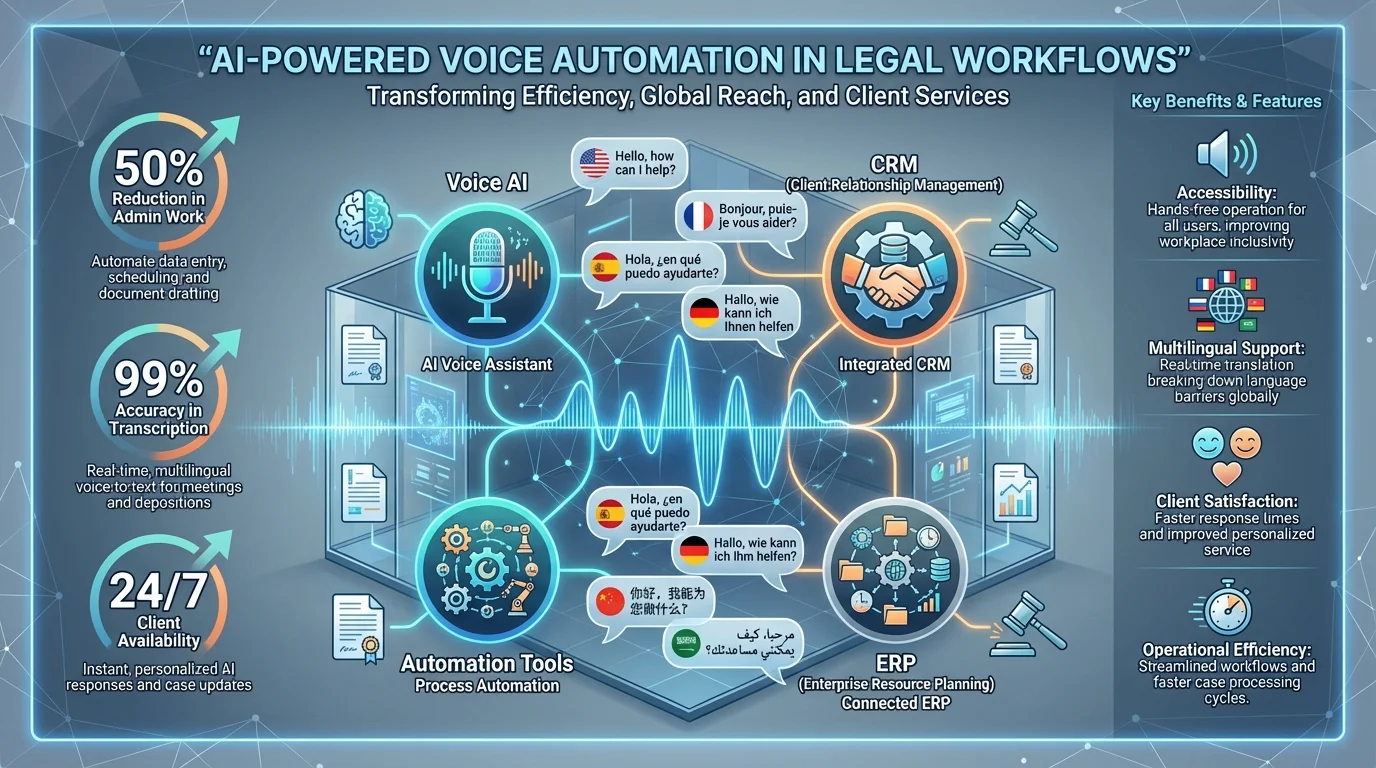
The Impact of AI-Powered Voice Automation on Legal Workflows
Transforming Legal Workflows_ How AI-Powered Voice Automation is Revolutionizing Law Firms
The rapid adoption of AI-powered voice automation is transforming the legal sector, streamlining processes and improving accessibility for law firms worldwide. The integration of advanced technologies—including those developed through collaborations such as ElevenLabs and Harvey—brings new levels of efficiency, communication, and client service to modern legal practices. This article explores how voice automation, particularly through multilingual and customizable AI solutions, is revolutionizing legal workflows, making legal knowledge more globally accessible, and setting the stage for future advancements.
AI Integration in Legal Workflows: Streamlining with CRM, ERP, and Automation
Modern law firms are increasingly reliant on sophisticated systems that automate and enhance their daily operations. The deployment of advanced Customer Relationship Management (CRM) and Enterprise Resource Planning (ERP) platforms, integrated with cutting-edge software automation tools, is central to this evolution.
- Case Management: Automated systems facilitate efficient scheduling, document storage, time tracking, and communication, reducing manual administrative tasks.
- Client Interactions: AI-driven chatbots and voice assistants offer 24/7 support for client inquiries, appointment setting, and document requests, improving client satisfaction and response times.
- Document Workflows: Automated drafting, review, and filing powered by AI-driven voice transcription and synthesis streamline the preparation of contracts, court submissions, and correspondence.
The collaboration between ElevenLabs and Harvey demonstrates how AI can deepen these efficiencies by seamlessly blending voice automation with existing legal technology stacks.
Multilingual Voice Automation: Breaking Communication Barriers
The legal sector’s global reach underscores the importance of effective multilingual communication. ElevenLabs is at the forefront of developing Text to Speech (TTS) and Speech to Text (STT) technologies that support dozens of languages and dialects. This advancement brings several benefits:
- Inclusive Client Service: Law firms can better serve multilingual clients, reducing miscommunication and ensuring precise legal counseling across linguistic divides.
- International Case Management: With voice AI able to provide real-time translations and transcriptions, attorneys can collaborate with global partners and clients seamlessly.
- Compliance and Record-Keeping: Accurate automated transcriptions in multiple languages help maintain thorough records, essential for international litigation and regulatory compliance.
By combining neural voice synthesis with powerful translation engines, firms increase accessibility and bridge cultural gaps, empowering legal professionals and clients worldwide.
The Power of Collaboration: ElevenLabs and Harvey Making Law Accessible
The partnership between ElevenLabs and Harvey exemplifies the potential of joining legal expertise with AI innovation. By integrating advanced voice technologies into legal workflows, they are making legal services more accessible and efficient globally.
- Democratizing Legal Knowledge: AI-powered voice assistants help break down barriers to legal information for individuals with disabilities, those in remote areas, or speakers of underrepresented languages.
- Efficient Knowledge Sharing: Law firm intranets and knowledge management systems leverage voice automation for swift information retrieval, making research and case preparation faster for lawyers.
- Enhanced Training and Compliance: Voice-mode simulations and spoken trial run-throughs aid in ongoing legal education, improving both learning outcomes and compliance.
This collaboration marks a pivotal advancement, enabling voice-driven access to complex legal data and contributing to a fairer, more inclusive system.
Emerging Voice Automation Features: Benefits and Challenges
Integrating features like multilingual voice translation, customizable tone, and spoken trial simulation into law firm workflows presents exciting opportunities and unique challenges.
Potential Benefits
- Increased Accessibility: Voice interfaces make legal resources usable for those with visual impairments or limited literacy.
- Operational Efficiency: Automated dictation and transcription reduce lawyer workloads and turnaround times.
- Personalized Client Experiences: Tone customization and multilingual support enable more empathetic and tailored client communications.
- Enhanced Trial Preparation: Spoken simulations help attorneys prepare more effectively for courtroom scenarios.
Challenges to Consider
- Confidentiality: Using AI voice tools requires rigorous security and privacy protocols to ensure sensitive information remains protected.
- Accuracy: While AI has advanced rapidly, perfect accuracy in multi-language legal transcription and translation is still a work in progress.
- User Adoption: Lawyers and clients may face a learning curve when transitioning to new voice-based technologies.
- Regulatory Considerations: Ensuring compliance with data privacy and legal sector regulations is essential as new AI features are deployed.
Law firms adopting voice automation must proactively address these challenges to fully realize the benefits of innovation.
Case Studies: Transforming the Legal Experience with Voice AI
Real-world examples illustrate how AI-powered voice automation is reshaping law firm operations and client interactions:
- A major international law firm adopted voice transcription to automate meeting notes, reducing post-meeting administrative work by up to 50%.
- Attorneys representing clients in cross-border disputes now use multilingual speech-to-text tools to communicate efficiently with parties and courts across different jurisdictions.
- Legal aid organizations leveraged text-to-speech technologies to deliver critical legal information to visually impaired clients or individuals in remote communities.
- Training departments introduced spoken trial simulations, enabling new lawyers to practice litigation skills in realistic, voice-driven scenarios.
These examples underscore the tangible improvements in both professional efficiency and client services achieved through voice automation in legal settings.
Thought Leaders, Credibility, and the Future of Legal AI
The credibility of sources reporting on AI advancements is crucial for understanding genuine progress in legal technology. Established industry analysts, academic leaders, and organizations specializing in legal tech innovation continue to shape the discourse. Notable thought leaders focus on ethical AI, inclusion, and the transformative potential of automation in law. Their research and guidance ensure that the future of legal AI is both innovative and responsible.
With ongoing developments led by top firms and technology partners, law firms can expect further enhancements in workflow efficiency, accessibility, and global reach. As AI-powered voice automation evolves, legal professionals must stay informed through trusted, expert-led channels to successfully integrate new capabilities and maintain competitive advantage.
Conclusion: The Future of Legal Workflows Enhanced by Voice AI
AI-powered voice automation, highlighted by collaborations like ElevenLabs and Harvey, is driving foundational change in the legal sector. From improving case management and multilingual communication to making legal knowledge universally accessible, these technologies offer law firms unparalleled tools for the future. By navigating challenges around privacy, accuracy, and compliance, and by drawing on the expertise of industry thought leaders, law firms are set to deliver better, faster, and fairer services to clients everywhere. The ongoing transformation promises a more inclusive, efficient, and accessible future for law.